
2026 Chattanooga’s Data Loss Exposes the Cost of Outsourcing | Trendspot Media
When a California cloud company allegedly lost millions of dollars in city records, Chattanooga's bet on local procurement suddenly looked less like nostalgia and more like survival.
The phone call came in 2021, and it carried the kind of news that makes city administrators reach for antacids. Chattanooga's permit records, four years' worth of data covering millions of dollars in construction projects, were gone. Not misplaced. Not archived in some dusty server room. Gone.
The city had migrated its historical building permits to Accela's cloud platform, trusting the California-based software company to safeguard decades of inspection reports, variance approvals, and engineering sign-offs. When Chattanooga ended the contract and asked for its data back, Accela allegedly "failed to provide any records," leaving city staff unable to review critical information needed to evaluate new permit applications. The lawsuit that followed claimed "irreparable harm" and sought at least $75,000 in damages, but the real cost was harder to quantify: How do you price the institutional memory of an entire city's built environment?
For procurement officials in Chattanooga's municipal building, the Accela debacle crystalized a question that had been simmering for years: What does it actually cost when you send tax dollars 2,400 miles away to a vendor you'll never meet, operating under laws you can't enforce, holding data you can't retrieve?
The answer, according to a growing chorus of local business advocates, chambers of commerce, and economic development researchers, is exactly 30 cents on the dollar. That's the "leakage", the gap between the 73 dollars that stays in Chattanooga's economy when you buy from a local business versus the 43 dollars that remains when the same hundred-dollar bill flows to a national chain or out-of-state vendor. It's a number that has become something close to gospel in southeastern Tennessee, repeated in chamber presentations, printed on downtown restaurant placards, and woven into the civic identity of a city trying to rebuild its manufacturing base one food truck and SaaS contract at a time.
But here's the catch: Chattanooga isn't actually allowed to prefer local businesses when it spends public money.
The Law Says No
On November 25, 2013, Tennessee's Attorney General issued Opinion 13-92, a six-page legal memorandum that quietly kneecapped every city official who wanted to build "buy local" into their procurement process. The opinion interpreted the Municipal Purchasing Law of 1983,a statute requiring cities to use competitive bidding for most purchases, as fundamentally incompatible with local preference policies. "Due to this conflict," the AG wrote, "a municipality lacks the authority to adopt such a policy."
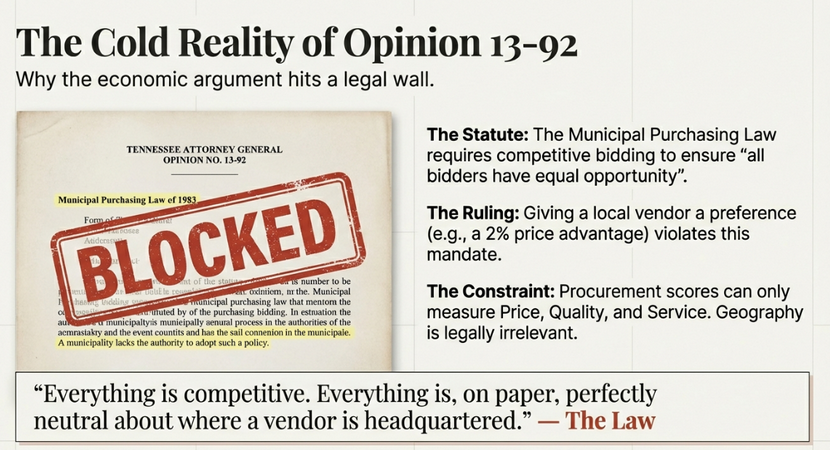
The reasoning was straightforward: Tennessee Code Annotated Section 6-56-304 demands that municipal purchases happen only "after public advertisement and competitive bid," with the explicit purpose of ensuring "all bidders have equal opportunity" and that bids are "made on substantially similar terms." A rule that gives Joe's Chattanooga Plumbing Supply a two-percent price advantage over Home Depot violates that equal-opportunity mandate. Full stop.
The 2013 opinion didn't create new law-it clarified what had been true since 1983. But its timing coincided with a national resurgence of "shop local" movements, particularly in post-recession cities scrambling to stabilize small business districts decimated by Amazon and Walmart. Chattanooga, still remaking itself from the "dirtiest city in America" moniker it earned in the 1960s, was already leaning into localism as part of its economic development story. Suddenly, the legal ground shifted.
So Chattanooga did what American cities have done for generations when federal or state law blocks a popular local initiative: It found the gray spaces.
The Workaround Economy
Walk into Chattanooga's Purchasing Division office and you'll find a manual, revised as recently as July 2022,that meticulously follows the state's competitive bidding rules. It includes ethics clauses specifying that buyers "shall not use their position to obtain benefits for organizations," procedures for public advertisement of bids, and step-by-step guidance on contract awards. Everything is above board. Everything is competitive. Everything is, on paper, perfectly neutral about where a vendor is headquartered.
But scroll to the city's Facebook page from January 27, 2026, and you'll see a very different tone. The Purchasing team promoted an event where local businesses could "learn about doing business with" the city, captioned with phrases like "our city's purchasing team wants to buy local" and "shop local, support local, buy local." Three months earlier, in March 2025, the city issued a news release explicitly calling for "small, local, and traditionally disadvantaged businesses" to sign up as city suppliers, stating that the initiative aimed to "ensure" such firms are "considered when the City purchases goods and services."
This is the dance: Chattanooga can't give local vendors a formal bidding advantage, but it can make sure local vendors know the city is buying. It can run supplier sign-up drives. It can host "how to bid with the city" workshops targeted at small businesses. It can ensure that when a request for proposals drops, local firms actually see it, something that doesn't happen when procurement notices get buried in the Tennessee state registry and nobody from Chattanooga Construction Supply thinks to check.
The strategy operates in what lawyers might call a "facts and circumstances" analysis. There's no local-bidder preference in the scoring rubric. But if 40 local companies bid on a project and only three national firms bother to respond, the math starts tilting local by pure volume. And if city buyers cultivate relationships with local suppliers through chamber events and business mixers, perfectly legal networking, those relationships can translate into faster response times, better customer service, and fewer lost permit records when a contract ends badly.
"We care deeply about all of our businesses and the employees and families who depend upon their success," said Christy Gillenwater, President and CEO of the Chattanooga Area Chamber of Commerce, when launching the "Chattanooga To Go" buy-local campaign during COVID-19. The chamber's membership is more than 90 percent small businesses, and the campaign, complete with a searchable directory, social media hashtags (#ChattanoogaToGo, #TakeoutTonightCHA, #Buylocal), and media partnerships, positioned local spending as both economic strategy and civic duty.

But was it actually true that local spending generated better returns? Or was this just feel-good marketing disguised as economic development?
The Economic Case
The 73-to-43 dollar split comes from Civic Economics, a consulting firm that has produced "local multiplier" analyses for dozens of cities. The methodology tracks how revenue circulates: Local businesses tend to bank locally, hire local accountants, advertise in local media, and purchase from other local suppliers, creating a secondary and tertiary ripple of spending. National chains, by contrast, send profits to distant shareholders, use centralized purchasing from national distributors, and employ corporate law firms in New York. The result: more leakage.
In Chattanooga's messaging ecosystem, the 73-dollar figure appears everywhere. Discover Dade, a tourism and economic development organization in an adjacent Georgia county within Chattanooga's metro sphere, uses it prominently: "The math for buying close to home is compelling," their website declares, contrasting the 73-dollar local retention with the 43-dollar retention from non-local businesses.
The chamber goes further, citing data that local restaurants return nearly 79 percent of revenues to the community versus just over 30 percent for chain restaurants. Another frequently cited stat: each dollar spent at a local small business generates 68 cents in additional local economic activity, compared to 48 cents at big-box stores.
These numbers pass the smell test, of course a locally owned HVAC company contributes more to Chattanooga's tax base and hiring pool than a Home Depot distribution center in Atlanta. But academic research on whether consumers actually care enough to pay extra for "local" tells a more complicated story.
The Premium Question
In 2016, researchers at the University of Tennessee studied Knoxville shoppers' preferences for locally grown produce versus out-of-state alternatives. The findings were surprising: "Consumers have no strong preferences for or against locally grown fresh produce." The key caveat: local prices had to be "less than or equal to" comparable out-of-state products. In other words, people liked the idea of buying local, but only if it didn't cost more.
A separate study on "Tennessee Milk", examining whether a state-branded logo could command premium pricing, found more encouraging results for localism advocates. Using a probit regression model with 352 observations, researchers determined that Tennessee consumers would pay approximately 12 percent more for milk labeled "TN Milk." But the study also noted that on average, respondents "neither agreed nor disagreed" that they would pay premiums for locally produced foods, with an average score of 2.91 on a 5-point scale. Translation: a passionate minority drives the local premium, not universal enthusiasm.
Multi-state research on farmstead dairy preferences, including Tennessee respondents, found mean Likert scores around 2.9 out of 5 for statements like "I purchase local foods on a regular basis" and "I am willing to pay premiums for local foods." People say they buy local regularly and read labels to check origin, but the scores hover in the middle, moderate behavior, not zealotry.
This creates a paradox for Chattanooga's buy-local movement: The economic multiplier effect is real (73 versus 43 dollars), but consumer willingness to pay extra is lukewarm unless you're talking about specific identity products like Tennessee-branded milk. For the Chattanooga Chamber's "To Go" campaign to work long-term, local businesses can't just be local-they have to be competitive on price, quality, and convenience, or the 73-dollar math never gets a chance to play out.
The Regional Echo Chamber
Drive 30 miles north into Catoosa County, Georgia, and you'll find another "Shop Local" campaign. Or head west to Walker County, where the Joint Comprehensive Plan encourages residents to "shop local whenever" as part of community engagement. Swing through Chickamauga, Georgia-a town of 3,100 people that adopted a formal "Shop Local Campaign" in 2017 as part of its Renaissance Strategic Vision, aiming to capture spending from both residents and tourists flowing up from Chattanooga.
The repetition isn't coincidental. Southeastern Tennessee and northwestern Georgia form an economic network where chambers of commerce, tourism boards, and downtown development authorities all learned the same lesson during the Great Recession: When Walmart and Amazon drain spending out of small-town main streets, the only defense is cultural-convincing people that buying local isn't just commerce, it's identity.
By 2020, that message had reached critical mass. When COVID-19 shut down in-person retail, the Chattanooga Chamber launched "Chattanooga To Go" within weeks, essentially digitizing the shop-local ethos. The campaign featured participation from the Chattanooga Times Free Press, multiple TV and radio stations, and was explicitly framed as preparation "for the recovery phase." More than just a directory, it was a social proof machine: post a photo of your takeout with #ChattanoogaToGo, and you're not just eating dinner-you're participating in civic resilience.
Local Fare Magazine reinforced the timing by promoting shop-local messaging around Black Friday 2025 and Small Business Saturday. HomeTown Credit Union ran an Instagram drawing in January 2026 offering $500 to customers who "SHOP LOCAL." Even the language calcified: "shop local, support local, buy local" became a mantra, repeated so often that it started to sound less like marketing and more like civic obligation.

(taken from their Instagram Account)
But underneath the feel-good messaging lurked a harder question: If buying local was such an obvious economic winner, why did it require constant, expensive campaigns to keep people doing it?
The Data Problem
Here's what nobody wants to say out loud in the chamber meetings: The 73-dollar multiplier, the 79-percent restaurant retention, the 68-cent secondary spending, all of these numbers come from advocacy organizations and consulting firms paid by local business coalitions. Civic Economics isn't a neutral academic institution. It's a private consultancy whose clients are usually the chambers and downtown alliances that want to hear that local spending works.
That doesn't make the numbers wrong. But it does mean they live in a different epistemological category than, say, the University of Tennessee's peer-reviewed research on local produce preferences or the multi-state dairy study published in the Journal of Food Distribution Research. The academic work consistently finds moderate consumer localism, people kinda-sorta care, especially for food, especially if prices are equal, but nothing like the passionate localism implied by campaign slogans.
The Tennessee Attorney General's 2013 opinion implicitly acknowledges this tension. By banning explicit local bid preferences, the AG was saying: We don't trust cities to make purely economic decisions when civic identity is involved. Competitive bidding exists precisely because human beings are bad at separating price, quality, and in-group loyalty when spending someone else's money. The law assumes that without forced competition, procurement becomes patronage.
Chattanooga's workaround, aggressively recruiting local vendors while maintaining competitive bid processes, tries to thread that needle. But it only works if local businesses can genuinely compete. And that's where the Accela lawsuit becomes more than just a cautionary tale about data migration.
The Accountability Gap
When Chattanooga sued Accela in 2021, the city's legal team alleged that the loss of permit records caused "irreparable harm" by crippling its ability to evaluate "millions of dollars in new permit requests." The lawsuit sought damages "no less than $75,000" and demanded return of the data Accela had hosted for four years.
The dollar figures understate the problem. Permit records aren't just receipts, they're institutional knowledge. They document soil conditions, load-bearing modifications, electrical upgrades, and variance approvals that inspectors reference decades later when evaluating adjacent projects. Lose that history, and you're essentially forcing city engineers to make million-dollar infrastructure decisions blind.
Could a Chattanooga-based software company have prevented this? Maybe not, data loss can happen anywhere. But the lawsuit revealed a more fundamental issue: When a vendor is in California and the contract goes south, your leverage is a federal lawsuit that will take years and cost more than the contract was worth. When a vendor is on Broad Street and the project fails, your leverage is walking into their office Monday morning and demanding fixes, backed by the implicit threat that every chamber member and city council contact will hear about it by lunch.
This is the unspoken value proposition of local procurement: proximity as accountability. It's not in the Civic Economics multiplier studies, and it's not quantifiable in Tennessee milk premium research. But for city administrators who've watched out-of-state vendors ghost them after collecting payment, it's real.
Of course, proximity cuts both ways. Local vendors can be incompetent. They can overbill. They can be the mayor's brother-in-law who got the contract because of a handshake at the Rotary Club. This is exactly why the Municipal Purchasing Law exists, to force cities to look beyond the cozy in-group and consider whether Joe's Plumbing Supply is actually $15,000 better than the national distributor bidding half-price.
The ideal outcome is what Chattanooga is attempting: broad outreach that fills the bid pool with local firms, then genuine competition that ensures only the good ones win. But that only works if local businesses are actually competitive. And in industries where scale matters, think cloud software, specialized construction equipment, or enterprise IT, local often can't compete on price.
The 2026 Reality
On a cold January morning in 2026, the City of Chattanooga's Purchasing Division posted on Facebook about an upcoming workshop for local businesses interested in bidding on city contracts. The language was careful, "learn about doing business with the City," not "get a preference." But the subtext was clear: We want you in the bid pool.

That same month, HomeTown Credit Union was giving away $500 to customers who shopped local, and Local Fare Magazine was running "shop local" holiday promotions. The cultural machinery that launched with "Chattanooga To Go" in 2020 had become self-sustaining, running on autopilot through chambers, credit unions, media outlets, and downtown development boards.
But six years after COVID forced the buy-local question into sharp relief, the actual policy landscape hadn't changed. The 2013 Attorney General opinion still stood. The Municipal Purchasing Law still required competitive bids. Chattanooga still couldn't formally prefer local vendors, no matter how many workshops it hosted or multiplier studies it cited.
What had changed was the sophistication of the workaround. City procurement officials had learned that you don't need to change the law if you can change who shows up to bid. Make sure local firms know about opportunities. Make sure they understand the RFP process. Make sure they're registered in the vendor database. Then let competition do its work.
The Accela lawsuit settled quietly, terms undisclosed. The city eventually recovered its permit data, though the details remain murky. Somewhere in Chattanooga's municipal building, a procurement officer probably flagged "cloud data migration" as a category that deserves extra scrutiny when evaluating out-of-state vendors. Not a formal preference. Just... scrutiny.
And that's the real story of Chattanooga's buy-local movement: Not a legal mandate or a policy revolution, but a thousand small decisions, a workshop here, a vendor signup drive there, a chamber campaign that makes supporting local feel like supporting your neighbors, that collectively shift where money flows without ever technically violating the competitive bidding law.
The 73 dollars that stay local versus the 43 dollars that leave? Those numbers might come from advocacy groups with an agenda. But walk through Chattanooga's Southside district on a Saturday afternoon, past the locally owned breweries and the Tennessee-made craft shops, and you can see the bet the city has made: that enough people care about keeping money local, or at least can be reminded to care, that the math works even without formal legal preference.

The Accela lawsuit suggested that sometimes, proximity is worth more than efficiency. The Tennessee milk study suggested that some consumers will pay a premium for local, at least for the right products. The Knoxville produce research suggested that most won't, unless local is equal or cheaper.
Chattanooga's answer to that conflicting evidence? Build the infrastructure, the workshops, the vendor databases, the chamber campaigns, and let businesses compete. Then hope that the 73-dollar multiplier is real, that local vendors are actually good enough to win on merit, and that when the next Accela-sized disaster hits, the city administrator who has to make the call will remember that sometimes, the closest vendor isn't the cheapest, but they answer their phone.